The Landy Rover and the AN/KPQ-1
The AN/KPQ-1 Radar System in South Vietnam
The mortar locating system employed by Australian forces in South Vietnam (SVN) to locate, identify, and target enemy mortar positions comprised three main operational components: listening posts (LPs) for auditory and visual reports, the Task Force Artillery Intelligence Office (TFAIO) for mapping trajectory plots, and mobile Mortar Locating Radar (MLR) detachments.
Each Radar Section operated seven Land Rovers. One vehicle carried the Section Commander (a Long Wheelbase General Service Land Rover), while three Land Rovers were assigned to each active Radar Detachment. This transport capability was supported by Det 131 WKSPS providing a specialized radar mechanic vehicle. The three primary detachment vehicles included a General Service (GS) troop carrier pulling a generator trailer, plus two specialized radar component trucks designed to carry the computing and antenna gear.
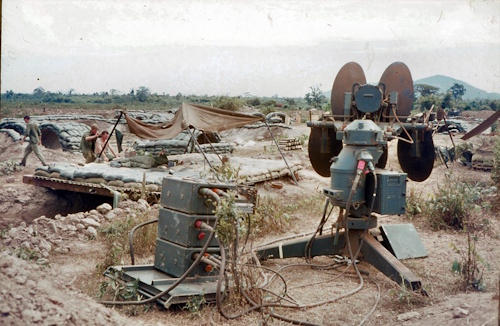
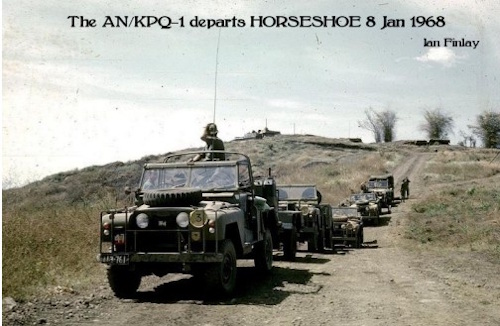
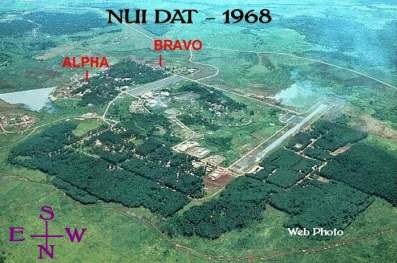
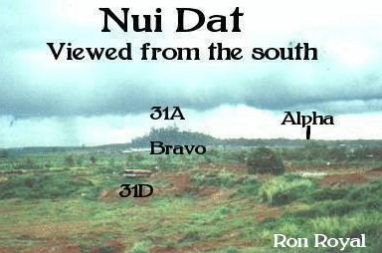
Official Australian Army registry records classify our vehicle—ARN 111-387—as a "Truck, Flatbed, 3/4 Ton, GS, Radar Set AN/KPQ1, No 2 Loading." Physical evidence uncovered during restoration (including original heavy-gauge wiring and military blackout light switches) indicates she was one of the three specialized component trucks attached to the 131st Divisional Locating Battery based at Nui Dat, South Vietnam.
According to historical records from the Army Museum Bandiana, the US-manufactured AN/KPQ-1 Mortar Locating Radar was introduced into the Australian Army in the early 1960s. The system tracked the trajectory of incoming high-angle projectiles and used an analog computer to backtrack the round to its exact firing origin, providing artillery command with precise grid coordinates for counter-battery fire at ranges up to 8.5 kilometers.
A full AN/KPQ-1 MLR detachment was staffed by 11 personnel (including the Detachment Commander, 5 radar operators, 3 signallers/drivers, a radar mechanic, and a driver). Equipment was divided across three modified 3/4-ton Land Rovers: Vehicle #1 carried crew gear and towed a heavy generator trailer; Vehicle #2 carried umbilical cable reels and towed the radar antenna tripod trailer; and Vehicle #3 carried the main antenna pedestal and antenna assembly trailer.