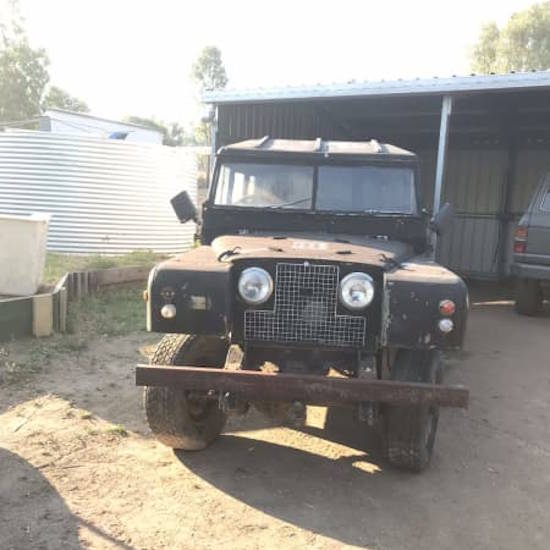
From Vietnam war service to the modern world, this Landy has lived a life. But her next big adventure starts now: in 2027, we're driving her from Brisbane to Birmingham.
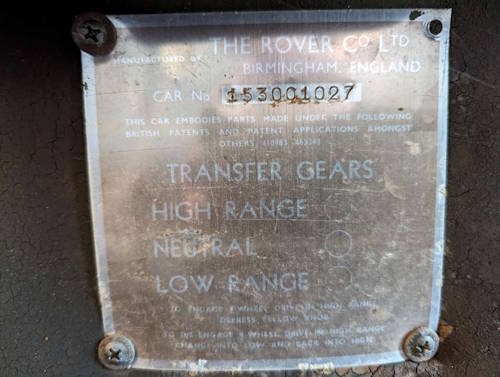
Our Landy left the UK production line as Car# 153001027, which translates as:
1 = Land Rover
53 = Series 2, 109in wheelbase, Petrol, RHD
0 = 1960
01027 = 1027th vehicle that year.
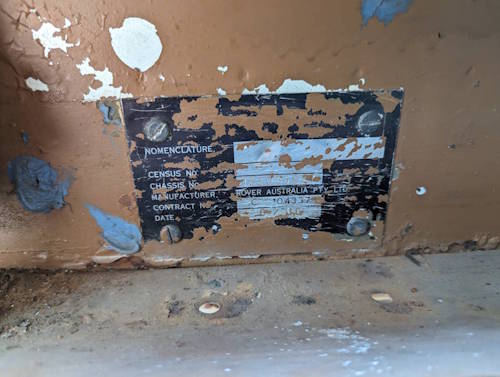
The army plate has been painted over and that sadly removed the black 'type text' on the plate. Engraved data shows the Landy entered the Aussie Army in June 1960, as part of Contract Number C104337, which was the first contract (purchase) for over 1000 vehicles and signed on the 16-12-1958. The first vehicles were not delivered until 1959 and continued for 12 months afterwards.
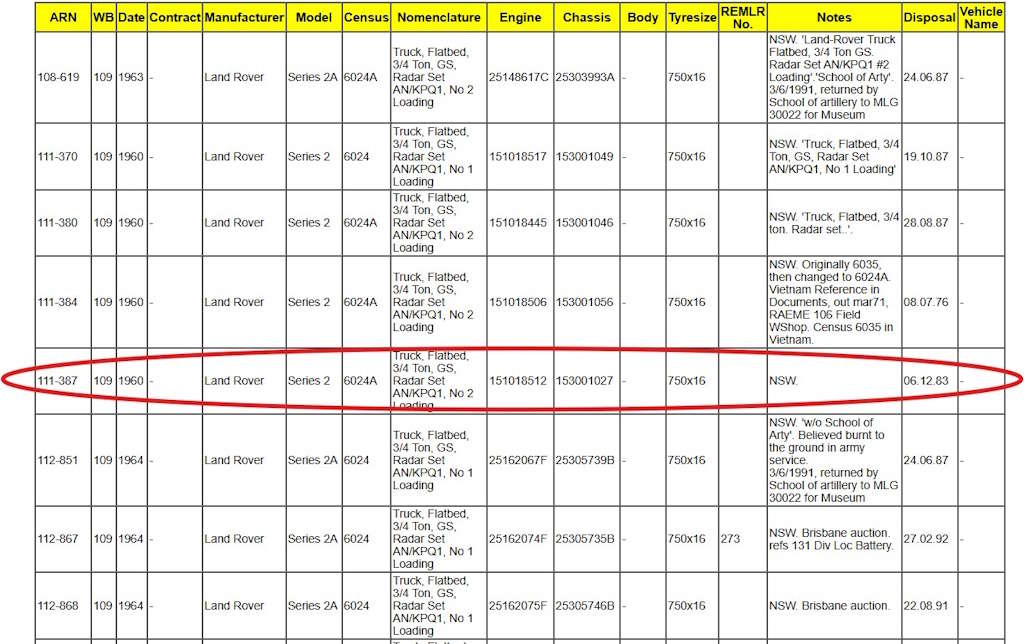
Her Army record shows ARN 111-387 as a "Truck, Flatbed, 3/4 Ton, GS, Radar Set AN/KPQ1, No 2 Loading" and she is a 1960, Long wheelbase (LWB) Series 2 and the original tyre size were 7.50/16 (These are the tyres I re-fitted during the restoration).
She left the Australian Defence Force on 6th Dec, 1983 in New South Wales.
The AN/KPQ1 was a mortar tracking radar system that was used to track incoming mortar fire from the enemy and pinpoint its location and more details can be found on the AN-KPQ-1 page.
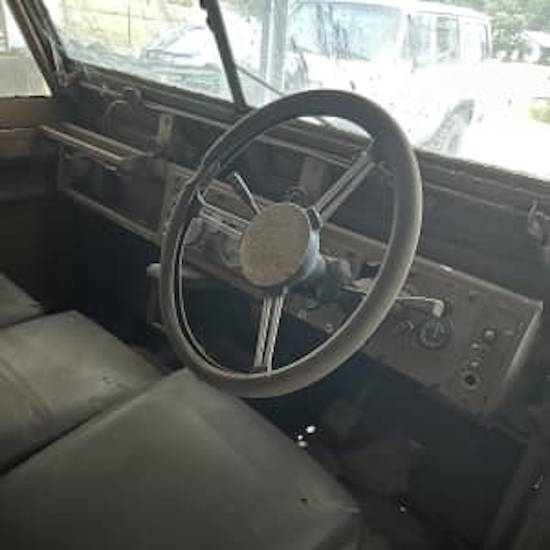
The Land Rover arrived in Vietnam in late 1960, and it is assumed she entered general service, but was then converted into the Flat Bed Truck for radar operations soon after. At some point during this time, the electrics were converted over to Negative Earth, and the army black-out light switches were installed. The key hole for the ignition was sealed up (so people didn't lose the keys), and a start button was installed, which I have retained. Very heavy-duty 2AWG cabling was installed for the radar electrical systems, which was still in place and has now been used for the engine starter motor and battery charging systems in the camper and the engine.
Technical Archaeology
While most Series 2 Land Rovers were general-purpose workhorses, ARN 111-387 was a specialist. As a "Truck, Flatbed, 3/4 Ton, GS, Radar Set AN/KPQ1, No. 2 Loading," its anatomy was dictated by the high-tech requirements of 1960s counter-mortar electronic warfare.
This is the most unique part of the Landy’s history. In a Radar Detachment, the "No. 2" truck was the mobile nervous system. Unlike a standard tub, the flatbed provided a wide, level platform essential for hauling massive interconnecting cable reels and the heavy antenna tripod. This allowed the crew to roll gear off the side quickly in combat zones.
Our restoration revealed remnants of specialized heavy-gauge wiring. These weren't for standard lights; they were likely part of the power distribution for the radar's computing unit. ARN 111-387 was also designed specifically to tow the specialized trailer carrying the radar antenna tripod.
Operating sensitive electronics in a Vietnamese monsoon required a heavy-duty canvas canopy to keep red dust and rain off the cables. To keep the crew and gear cool, these trucks often operated with door tops removed and windscreens folded down to maximize airflow.
| Feature | Radar Support (ARN 111-387) |
|---|---|
| Body Style | Flatbed / Chassis-Cab |
| Primary Load | AN/KPQ-1 Cables & Tripod |
| Towing | Radar Antenna Trailer |
| Role | Counter-Mortar Support |
Retirement on a NSW Farm
After the war The Land Rover remained in the army for some time, and it is known that the Landy was retired from the Australian Army in December 1983 and she went to work on a farm. Over the following 15 years, the original Land Rover Engine from the Army record was replaced with a Holden 202 (6 Cylinder) and replaced the 4.7:1 with 3.54:1 differentials, which was common conversion to gain more torque and power over the 2.25L 4 cylinder Land Rover engine. Add to that the engine mounts and gearbox bell housing bolts lined up perfectly and there was a abundance of these 'Red Motors', so they were easy to obtain.
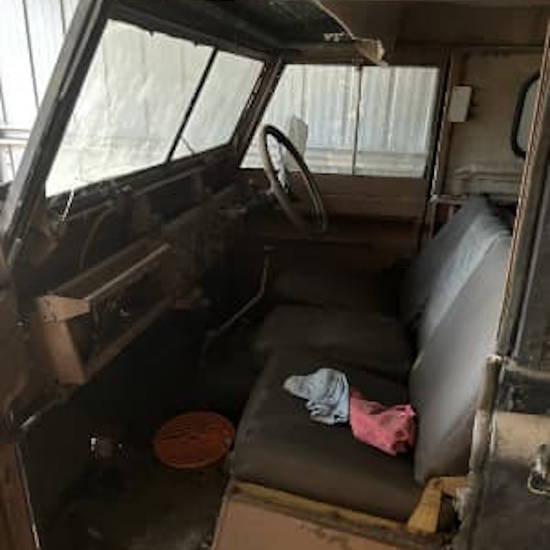
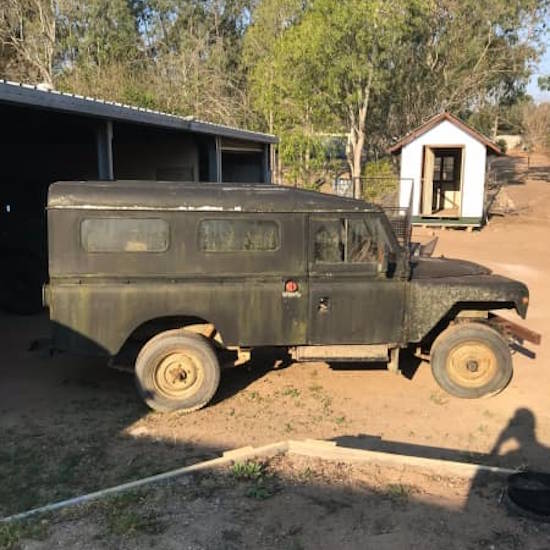
Based on the army record, the Landy was a 'flat bed truck', so the back tub, the sides and the roof would have been added at some point during this time, although the army dashboard and blackout lights were retained. The back chassis rails still have very heavy gauge copper cable installed and the rear differential still had the white paint for the blackout night operations. The army green paint was still under the black paint, so at some time, a rather quick respray was done in the black colour.
Waiting for a New Life
It is then known that around 1999 The Landy was moved to Queensland and was used on a small holding farm of a relative, until she finally died around 2006 or 2007 and there she stayed, sitting under a tree, with the minimal amount of steel on the vehicle slowly rusting away. In 2023 she was towed across the yard and next to a shed, where she was put up for sale. The price was $2500 (AUD) or "will swap for a small boat", so I paid the $2500.
Starting a New Life
On 30th September 2023, I picked up a rental trailer and drove to pick up the wounded war veteran to bring her back to the LandyRover shed, to start the restoration, and replace the seized Holden 202 with a rebuilt Land Rover 2.25L engine. The 'newer' Differentials installed back in the Holden days allows for higher speeds at lowers revs, however with a Land Rover 2.25L engine reinstalled, I now struggle on hills and I am pretty slow. This does have a positive side though, and it means I can cruise long distances with less power and burn less fuel on highways and major roads. Low Range 4WD still works perfectly, so I am now an off-road crusing machine! Who knows, I may even cruise her back to Vietnam one day as part of a much larger trip, however..... that is a story for another day.
I am always looking to expand the recorded history of ARN 111-387. If you served with the 131st Divisional Locating Battery, or if you have any information or original photographs of this specific Land Rover in service, I would love to hear from you.
Contact the LandyRover TeamDo you like this page or find it useful?