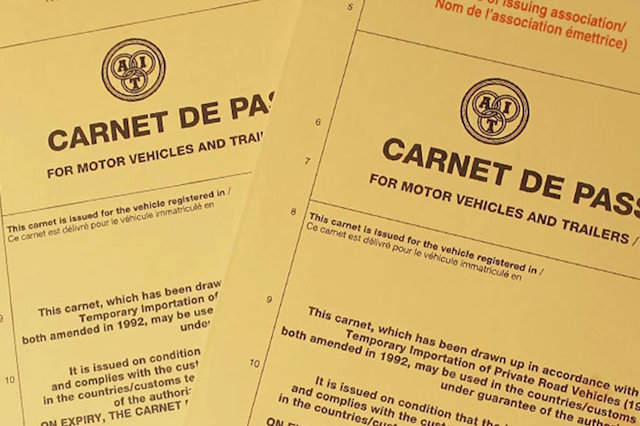
1. The Ground Rules & Acquisition Labyrinth
The first critical rule to remember: the Carnet is strictly for international touring purposes only. Your vehicle must remain actively registered in Australia for the entire duration of your overland trip. If your registration lapses back home, the Carnet technically voids, stalling your border hops immediately and nearly all countries will ask to see registration paperwork and some form of safety certificate to enter their country. Which poses a challenge, because Queensland doesn't have an annual check.
Acquiring the document is a process that takes you back to a time when life was much slower. You download a request form, fill it out by hand, and email it off to the Australian Automobile Association at international@aaa.asn.au. They then email you the required forms and once you hand over lots of cash, they print out the physical document and mail it to you! Whilst you are at it, you will also need an international driving permit for some countries too, and these can be obtained from RACQ or other state organisations. AANT in Darwin can provide them in their shop and they even use a glue stick to paste in your photo!.
The 12-Month Ticking Time Bomb & Processing Bottlenecks
A CPD Carnet is valid for only 12 months from the date of issue. Ideally, you want the paperwork to hit your hands 10 minutes before you start port procedures in Darwin (refer to our Darwin to Dili Shipping Guide) so you don't burn precious travel days, but it doesn't really work out like that. Standard AAA processing takes 10 business days, though they can expedite it for a painful additional emergency fee in as little as two days.
2. The Long Process for Extension
Because the carnet is restricted to 12 months, driving halfway across the planet on routes like our Brisbane to Birmingham Journey means you will inevitably have to extend it mid-journey, unless you plan on driving a lot of km each day. The process is a beautifully complex bureaucratic tango that you should start 1 to 2 months before expiry:
- Contact the AAA to request an extension.
- Provide your passport logs, full carnet numbers, current location details, and an official explanation for the extension.
- The AAA will request additional money from you (another application fee) before providing a "No Objection" letter, which you then present to the motoring organisation of the country you are in.
- The host country's motoring club takes that letter to their local Customs Authority to clear entry permissions.
- Once authorised, you must physically visit the overseas motoring club office to get the "Extension of Validity" section on the inside front cover endorsed with an official club stamp.
- Take the carnet to the local Customs Authority office for the final check stamp, then email a scan of the endorsed pages back to the AAA.
This is a long process and could easily take a few weeks, so you need to make sure you are in a country that allows you to stay at least 30 or 60 days and expect lots of frustration. Add to that confused looks from peole you speak to, mixed messages, and finally waiting for someone in a uniform using a big rubber stamp.
3a. Discharging the Document & Reclaiming the Bond - Back in Australia
When entering or leaving any nation, you must ensure the border officials stamp the correct counterfoil entry/exit slips. If you miss a single stamp, the carnet remains open, and you risk losing your deposit. When returning the vehicle to Australia, ensure the last foreign port applies a clean discharge customs stamp so the Australian Border Force can clear the vehicle profile smoothly upon entry.
Crucially, make sure Australian Customs fills out the Certificate of Location at the back of the carnet booklet. Once verified, mail the physical booklet back to the AAA at GPO Box 1555, Canberra ACT 2601 to unlock your cash reservoir.
3b. Discharging the Document from Europe (UK/EU Exit Protocol)
If your final expedition leg wraps up inside the United Kingdom or the European continent, you face a unique logistical challenge: because European borders no longer require or stamp a CPD Carnet, you cannot obtain a standard exit customs stamp. However, mailing the paper booklet back to Canberra without proper validation will result in the AAA assuming the vehicle was abandoned or sold illegally overseas, putting your $5,000 bond at severe risk. Make sure the last country (normally Turkey) that accepted the CPD stamps the vehicle out.
To safely execute a remote discharge from Europe and secure your refund, you must complete the official Certificate of Location framework before the booklet leaves your possession:
Step A: Physical Verification
You must physically take your vehicle to a regional Customs Authority office, a designated international port custom house, or an approved motoring association inside Europe. A customs official must inspect the vehicle in person to verify that the VIN, chassis number, and engine block match your registration document exactly.
Step B: Sign-Off the Certificate
Have the inspecting official complete, sign, and apply their formal institutional stamp to the Certificate of Location page located on the very last sheet of your physical carnet book. This signed declaration serves as your legal proof to the AAA that the vehicle has safely exited the carnet enforcement zones. Remember, this process may take a couple of weeks too, so don't leave this to the last day of the 12 months validity.
Once the Certificate of Location is signed and officially stamped, package up the entire original paper notebook and send it back to Australia using a tracked, secure international courier service (like DHL or FedEx). Never trust this booklet to standard international post - if the physical document is lost in transit, recovering your deposit becomes an absolute nightmare, if not impossible. The deposit might not be returned straight away either and there have been cases where the deposit was held just in case there were any later claims. It is safest to assume that you WILL probably lose your deposit due to misplaced stamps, the wrong colour pen, struggling to find a local motoring organisation that knows what you are talking about, and then relying on international post. If you do manage to get it back, think of it like finding some cash in a pocket after the clothes have been through a washing machine. If you do get it returned, you will not get any interest for your $5,000 sitting in a bank account either. Just be thankful you got it back.
Important UK Re-Registration Catch
Remember, the Australian carnet requires the vehicle to maintain active domestic registration in Australia up to the exact date of discharge, so keep the Rego current in Australia the whole time. If you plan to keep the vehicle in the UK or Europe long-term after your bond is released, you must immediately transition the registration onto UK classic plates or a local registry system to avoid operating a legally stranded vehicle.